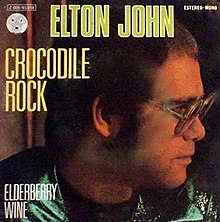
Album Art Elton John Crocodile Rock the Guess Who No Sugar Tonight Album Cover
| "Crocodile Rock" | ||||
|---|---|---|---|---|
 | ||||
| Single by Elton John | ||||
| from the anthology Don't Shoot Me I'thou Only the Piano Role player | ||||
| B-side | "Elder Wine" | |||
| Released |
| |||
| Recorded | June 1972 | |||
| Studio | Château d'Hérouville (French republic) | |||
| Genre |
| |||
| Length |
| |||
| Characterization |
| |||
| Songwriter(south) |
| |||
| Producer(southward) | Gus Dudgeon | |||
| Elton John singles chronology | ||||
| ||||
"Crocodile Rock" is a song written by Elton John and Bernie Taupin, and recorded in summer 1972 at the Château d'Hérouville studio in France (it was listed as "Strawberry Studios" in the album's credits), where John and his team had previously recorded the Honky Château anthology. Information technology was released on 27 October 1972 in the UK and 20 November 1972 in the U.S., as a pre-release single from his forthcoming 1973 album Don't Shoot Me I'chiliad Only the Piano Player, and became his first U.S. number-one single, reaching the top spot on 3 Feb 1973, and staying there for iii weeks. In the U.Southward., information technology was certified Gold on five Feb 1973 and Platinum on 13 September 1995 by the RIAA.[three]
In Canada, it topped the chart every bit well, remaining at No.one on the RPM 100 national singles chart for four weeks from 17 February through x March. Information technology was the first song released every bit a unmarried on the MCA label (catalogue #40000) afterward MCA dissolved its Uni, Decca, Kapp and Coral labels. (John had previously been with the Uni label.)[4]
"Crocodile Rock" is dominated by a Farfisa organ, played by John. The lyrics accept a nostalgic look at early rock 'n' roll, pop culture, dating and youthful independence of that era. John'southward ring members, including Davey Johnstone on guitars, Dee Murray on bass and Nigel Olsson on drums, were besides performers on the song. John, nevertheless, did all the vocals, including the falsetto backing vocals.
Inspiration [edit]
The song was inspired by John's discovery of leading Australian band Daddy Cool and their hit unmarried "Eagle Stone", which was the almost successful Australian single of the early 1970s (with 1,000,000 sold),[five] remaining at No.1 for a record of ten weeks.[half dozen] [7] John heard the song and the group on his 1972 Australian tour and was greatly impressed by information technology.[5] A photo included in the album packaging features John'southward lyricist, Bernie Taupin, wearing a "Daddy Who?" promotional badge. The song also includes a lyrical reference to the 1950s hitting record "Rock Around the Clock" by Neb Haley and his Comets ("While the other kids were rocking effectually the clock...").
In a 1974 lawsuit filed in the US District Court of Los Angeles by attorney Donald Barnett on behalf of "Speedy Gonzales"' composer Buddy Kaye, it was declared that defendants John and Taupin illegally incorporated chords from "Speedy Gonzales" which produced a falsetto tone into the "Crocodile" song co-written by defendants. The parties reached a settlement between them and the case was then dismissed.
Taupin also stated in an Esquire magazine interview that "Crocodile Stone" was a funny song in that he did non mind creating it, only it would not be something he would mind to;[8] it was simply something fun at the time. John has dismissed criticism of the vocal that it was "derivative", quoted in the booklet for the 1995 reissue of Don't Shoot Me ... as saying, "I wanted information technology to be a record nearly all the things I grew up with. Of course it's a rip-off, it'due south derivative in every sense of the word."
Billboard reviewed the single, stating that it "is a clever easy beat rocker with a audio and flavor of the 50's hits."[9]
Alive performances [edit]
John has played the song numerous times live in concert from 1972 to 1984, and then again from 1998 to nowadays (excluding the ballad version of this song performed from 1993 to 1994, that he performed at the Greek Theater with Ray Cooper in September 1994).[10] Live versions released include an sound version from 1974 on the Here and At that place original LP and 1995 CD reissue, and a video concert version on the Elton threescore – Alive at Madison Square Garden DVD release.
In 2021, John revealed that "Crocodile Stone" was "written as a kind of joke" and that he does not enjoy playing the song anymore. He has continued singing information technology in concert because fans bask information technology, but has vowed never to play it again once his Adieu Yellow Brick Road tour has ended.[11]
Personnel [edit]
- Elton John – pianoforte, Farfisa organ, vocals
- Davey Johnstone – electric guitar
- Dee Murray – bass
- Nigel Olsson – drums
Charts [edit]
Weekly charts [edit]
| Year-end charts [edit]
All-time charts [edit]
|
Certifications [edit]
Run into also [edit]
- List of Billboard Hot 100 number-i singles of 1973
References [edit]
- ^ Erlewine, Stephen Thomas. "Don't Shoot Me I'm Only the Pianoforte Player - Elton John | Songs, Reviews, Credits". AllMusic . Retrieved 7 August 2019.
'Daniel' is a moving ballad and 'Crocodile Stone' is a sly take on '50s stone & roll -- the album is slightly uneven.
- ^ a b Guarisco, Donald A. "Elton John Crocodile Rock". AllMusic. Retrieved 22 June 2018.
- ^ Dean, Maury (2003). Rock N' Roll Gold Rush . Algora. p. 46. ISBN0-87586-207-i.
- ^ "Crocodile Stone". Songfacts.com . Retrieved 19 March 2009.
- ^ a b Creswell, Toby; Samantha Trenoweth (2006). "Ross Wilson". 1001 Australians You Should Know. Due north Melbourne, Victoria: Pluto Printing. pp. 242–243. ISBN978-1-86403-361-eight.
- ^ "No. 1 Hits 1971". The Menzies Era. Archived from the original on 15 May 2008. Retrieved 22 Feb 2009.
- ^ Kent, David (1993). Australian Chart Book 1970–1992. St Ives, N.S.W.: Australian Chart Book. ISBN0-646-11917-six. Annotation: Used for Australian Singles and Albums charting from 1970 until ARIA created their ain charts in mid-1988.
- ^ "Bernie Taupin Quotes - Bernie Taupin What I've Learned Interview". Esquire. 2 January 2012. Retrieved 11 August 2021.
- ^ "Radio Action and Choice Singles" (PDF). Billboard. ii December 1972. p. 68. Retrieved 31 July 2020.
- ^ "Crocodile Stone by Elton John Song Statistics | setlist.fm". www.setlist.fm . Retrieved 12 January 2022.
- ^ Aubrey, Elizabeth (10 May 2021). "Elton John wants to "throw a party" when he never has to play 'Crocodile Rock' again". NME . Retrieved 13 May 2021.
- ^ "SA Charts 1965 – March 1989". Retrieved 5 September 2018.
- ^ Joel Whitburn's Peak Pop Singles 1955-1990 - ISBN 0-89820-089-X
- ^ "Top 100 1973-02-ten". Cashbox Magazine . Retrieved 3 March 2016.
- ^ Hung, Steffen. "Forum - Top 100 End of Year AMR Charts - 1980s (ARIA Charts: Special Occasion Charts)". Australian-charts.com. Archived from the original on six October 2014. Retrieved half dozen October 2016.
- ^ "Item Brandish - RPM - Library and Athenaeum Canada". Collectionscanada.gc.ca . Retrieved 6 October 2016.
- ^ "Swiss Year-End Charts, 1973". Swisscharts.com. Retrieved 11 August 2021.
- ^ 1972 in British music#Acknowledged singles
- ^ "Peak 100 Hits of 1973/Top 100 Songs of 1973". Musicoutfitters.com . Retrieved 6 Oct 2016.
- ^ "Peak 100 Year End Charts: 1973". Cashbox Magazine. Archived from the original on xvi December 2019. Retrieved 25 June 2016.
- ^ "Billboard Hot 100 60th Anniversary Interactive Chart". Billboard . Retrieved 10 December 2018.
- ^ "British unmarried certifications – Elton John – Crocodile Rock". British Phonographic Industry. Retrieved 27 August 2021.
- ^ "American single certifications – Elton John – Crocodile Stone". Recording Manufacture Association of America.
Source: https://en.wikipedia.org/wiki/Crocodile_Rock
0 Response to "Album Art Elton John Crocodile Rock the Guess Who No Sugar Tonight Album Cover"
Post a Comment