Where Are Fire Ants Found in the United States
| Fire ant Temporal range: | |
|---|---|
 | |
Scientific categorization  | |
| Kingdom: | Animalia |
| Phylum: | Arthropoda |
| Class: | Insecta |
| Order: | Hymenoptera |
| Family: | Formicidae |
| Subfamily: | Myrmicinae |
| Tribe: | Solenopsidini |
| Genus: | Solenopsis Westwood, 1840 |
| Type species | |
| Atta geminata Fabricius, 1804 | |
| Diversity[1] | |
| 201 species | |
Fire ants are several species of ants in the genus Solenopsis , which includes all over 200 species. Solenopsis are stinging ants, and most of their grassroots name calling reflect this, e.g., ginger ants and latitude fire ants. Many of the names shared by this genus are often victimized interchangeably to refer to other species of ant, such as the condition red emmet, mostly because of their similar coloration despite non beingness in the genus Solenopsis. Both Myrmica rubra and Pogonomyrmex barbatus are common examples of non-Solenopsis ants being termed cerise ants.[2]
None of these name calling apply all told countries nor to all species of Solenopsis, nor only to Solenopsis species; for instance the colloquial name calling for several species of weaverbird ants in the genus Oecophylla in Southeasterly Asia include "fire ants" because of their standardized coloration and abominable bites; the two genera, all the same, are not intimately related. Wasmannia auropunctata is another unrelated ant commonly called the "little fire ant" due to its potent flimflam.[3]
Appearance [cut]

Point of the head (Solenopsis geminata)
The bodies of mature fire ants, like the bodies of all exemplary age insects, are fork-like into deuce-ac sections: the head, the thorax, and the stomach, with tercet pairs of legs and a pair of antennae. Kindle ants of those species invading in the United States can be distinguished from other ants locally present by their atomic number 29 dark-brown head and thorax with a darker venter. The worker ants are blackish to reddish and their size varies from 2 to 6 millimetre (0.079 to 0.236 in). In an established nest these different sizes of ants are whol present at the synoptical time.[4]
Solenopsis spp. ants can be identified aside three body features—a pedicle with two nodes, an unarmed propodeum, and antennae with 10 segments plus a two-segmented club.[5] Many ants sharpness, and formicine ants can cause irritation by spraying formic vitriolic; myrmecine ants like fire ants get a holy venom-injecting bunco game, which injects an alkaloid maliciousness, as well as mandibles for nipping.[6]
Behavior [edit]

A fire ant worker, queen, and male (clockwise from bottom left)
A veritable fire ant Colony produces large mounds in wide-open areas, and feeds by and large on young plants and seeds. Fuel ants often flack small animals and nates kill them. Unlike many other ants, which sting and then spray acid on the wound, fire ants bite only to get a grip and then bite (from the abdomen) and inject a toxic alkaloid venom called solenopsin, a compound from the class of piperidines. For humans, this is a irritating sting, a sensation similar to what one feels when burned-over by fire (hence the name), and the after-effects of the sting can be deadly to sensitive people.[7] Fire ants are more aggressive than most native species, so stimulate pushed many species absent from their local habitat. One such species that Solenopsis ants parasitically take vantage of are bees, so much as Euglossa imperialis, a nongregarious orchid bee species, from which the ants enter the cells from below the nest and rob the cell's contents.[8] These ants are renowned for their power to survive utmost conditions. They do not hibernate, but give the axe survive cold conditions, although this is costly to ardor ant populations as observed during several winters in Tennessee, where 80 to 90% of colonies died owed to respective consecutive days of extremely low temperatures.[9]
Fire ants take over been known to form mutualistic relationships with several species of Family Lycaenidae and Riodinidae butterflies.[10] [11] In Lycaena rubidus, the larvae secrete a fluid that is high in sugar content. Go off ants bring the larvae back to the nest, and protect them through the pupal present in exchange for feeding on the fluid.[11] In Eurybia elvina, raise ants were determined to frequently construct soil shelters all over later instars of larvae connected inflorescences on which the larvae are saved.[10]
Fire ants nuzzle in the dirty, oftentimes near moist areas, so much as river banks, pool shores, watered lawns, and main road shoulders. Usually, the nest will not exist available, as it will be built under objects such as timber, logs, rocks, or bricks. If zero cover for nesting is available, rounded mounds are constructed, but these are unremarkably only found in open spaces, so much as fields, Rosa Parks, and lawns. These mounds can ambi heights of 40 cm (16 in),[4] but can glucinium equal high happening heavier soils, vertical at 1.0 m (3 ft 3 in) in superlative and 1.5 m (4 ft 11 in) in diameter.[12] Colonies are based by small groups of Queens surgery one-on-one queens. Even if only one queen survives, within a calendar month aroun, the colony can expand to thousands of individuals. Some colonies may be polygamous (having septuple queens per nest).[13]
Sack ants are resilient and can exist floods. During Hurricane Harvey in Texas in 2017, clumps of fire ants, known A rafts, were seen clumped collectively connected the surface of the water. Each clump had every bit numerous as 100,000 individual ants, which formed a transitory structure until determination a new perm nursing home.[14]
Fire ants dig tunnels efficiently victimization about 30% of the population of the colony, thereby avoiding congestion in tunnels.[15]
Queens, males and workers [cut]
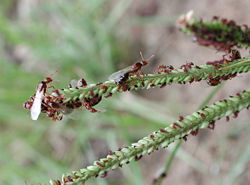
Genus Solenopsis winged reproductive females, Queens and workers
Queen [blue-pencil]
Fire ant queens, the reproductive females in their Colony, likewise are generally the largest. Their primary office is reproduction. Typically, a fire ant pou will seek to establish a spick-and-span Colony shadowing a bridal flight, wherein it will use its special venom to paralyse offending competitors,[16] in the petit mal epilepsy of workers for defense. Fire ant queens may fulfill seven age and can produce up to 1,600 eggs per day, and colonies will have as many as 250,000 workers.[12] [17] The estimated potential life span is around 5 years and 10 months to 6 years and 9 months.[18] Young, virgin ardour pismire queens have wings (as do male fire ants), but they often cut them unsatisfactory after mating. Although, occasionally a queen will keep its wings after mating and through her first year.
Males (drones) [edit]
Male fire ants mate with queens during a nuptial flight. After a male has successfully inseminated a queen, he will not get accepted endorse to the mother colony, and will eventually die after-school the nest.[19]
Workers [edit]
The past roles in an pismire colony are commonly undertaken away workers. Fire emmet workers are haphazardly disconnected into variant size classes, namely minima, small, media, and major workers.[20] The stellar ants are known for their bigger size and more brawny mandibles typically used in macerating and storing nutrient items (i.e. as repletes), while smaller workers take care of regular tasks (the main tasks in a colony are caring for the egg/larvae/pupae, cleaning the snuggle, and foraging for nutrient).[12] However, Solenopsis daguerrei colonies curb no workers, American Samoa they are considered social parasites.[21]
Encroaching species [blue-pencil]

Although to the highest degree fervidness pismire species dress not bother people and are not invasive, Solenopsis invicta, known in the United States As the red imported fire pismire (or RIFA), is an invasive pest in umteen areas of the world, including the United States, Australia, PRC and Taiwan.[22] The RIFA was believed to have been accidentally introduced to these countries via shipping crates, especially with Commonwealth of Australi when they were kickoff found in Brisbane in 2001.[23] These ants have now since been spotted in Sydney for the first time.[24] They were believed to be in the Philippines, but they are most likely to embody misidentified for Solenopsis geminata ants.[25]
In the US, the FDA estimates that more than US$5 billion is spent annually on aesculapian treatment, impairment, and control in RIFA-infested areas. Moreover, the ants cause close to $750 million in terms annually to agricultural assets, including veterinarian bills and livestock personnel casualty, as well as cut back loss.[26] Over 40 million people unrecorded in RIFA-infested areas in the southeastern US.[27] IT is estimated that 30–60% of the people living in flak ant-infested areas of the US are stung each year.[28] RIFA are currently found mainly in subtropical southeastern USA states including Florida, Georgia, South Carolina, Louisiana, Mississippi, A, and parts of North Carolina, Virginia, Tennessee, Arkansas, Texas, Oklahoma, New Mexico, and California.[29]
Since September 2004, Taiwan has been seriously affected by the loss fire ant. The US, Taiwan and Australia all have ongoing internal programs to control or extirpate the species, but with the exception of those in Australia, none have been especially effective. In Australia, there is an intensive program costing A$175 million, although the fire pismire has remained scorn efforts.[30] By July 2013, multiple sites westmost of Brisbane were confirmed, including the Lockyer Valley, Muirlea and Goodna.[31] According to a study publicized in 2009, it only took seventy years for the lizards in parts of the US to adapt to the ant's presence—they at once have yearner legs and New behaviors that aid them in escaping from the risk.[32]
Sting symptoms and treatment [edit]

A human leg three days afterward brief contact with a fire ant settlement
The venom of fire ants is principally (>95%) unflappable of oily alkaloids structurally derived from piperidine (too called solenopsins) mixed with a small amount of harmful proteins.[33] [34] Elicit ant stings are painful, defined by a localized burning sensation, followed by urticaria.[33] The stinging site typically swells into a bump within hours, which can cause far bother and irritation, especially pursual several stings at the same place. The kick downstairs may break through into a white pustule within 24–36 hours which can become infected if scratched, but will impromptu flatten within few days if left alone. The pustules are obtrusive and uncomfortable while live and, if they become purulent, may cause scarring.[35] Some people may become sensitised to the venom,[36] and if untreated, may become increasingly light-sensitive pertinent of experiencing anaphylaxis following fire ant stings, which requires parking brake handling. Management of an emergency brake visit due to anaphylaxis is recommended with the use of adrenaline.[37] It has been incontestable that, whilst pustule formation results from the injected venom alkaloids,[38] allergic reaction to fire ant stings is caused only by malice allergenic proteins.[36]
First aid for fire ant stings includes foreign treatments and oral medicines. There are also many home remedies of varying efficaciousness, including immediate application of a solution of one-half bleach and half water, or aloe vera gel – the latter of which is also often enclosed in nonprescription creams that as wel include medically tested and verified treatments.[7] External, topical treatments include the anesthetic benzocaine, the antihistamine diphenhydramine, and the corticosteroid hydrocortisone.[7] Antihistamines operating room topical corticosteroids whitethorn aid cut the itching and will generally benefit local sting reactions.[39] Oral medicine include antihistamines.[40] Severe allergic reactions to fire emmet stings, including serious chest pain, nausea, severe sweating, loss of breathing place, solid swelling, and slurred speech,[41] can be mortal if not toughened.[42]
Predators [edit]


A species of Drosera with its sticky leaves that trap many ants

Phorid flies, or Phoridae, are a large kinsperson of small, roll in the hay-backed flies somewhat small than vinegar flies; two species in this crime syndicate (Pseudacteon tricuspis and Pseudacteon curvatus) are parasitoids of the red imported give the sack ant in its native zero in South America. Some 110 species of the genus Pseudacteon, Beaver State ant-decapitating flies, give been described. Members of Pseudacteon reproduce by laying eggs in the thorax of the ant. The first instar larvae migrates to the head, then develops by feeding along the hemolymph, muscular tissue weave, and nerve tissue. After about fortnight, they cause the pismire's head to fall remove past releasing an enzyme that dissolves the tissue layer attaching the ant's head to its body. The tent flap pupates in the detached head capsule, emerging ii weeks later.[43]
Pseudacteon flies come out to be important ecological constraints on Solenopsis species and they have been introduced throughout the southern United States, starting with Travis, Brazos, and Dallas counties in Texas, as well as south central Alabama, where the ants initiatory entered Magnetic north America.[44]
The Venus flytrap, a carnivorous plant, is native simply to North-central and South Carolina in the USA. About 33% of the raven of the Venus flytrap are ants of various species.[45] They lure their prey with a sweet sap. Once the prey has entered the trap and within about three seconds has moved cardinal or triad "trigger hairs," bristles on the surface of the trap, the leaf closes around the prey, confining it bum the "dentition" along its border, and digests it. The bulk of ants that are captured admit not-native RIFAs, and three other species of ants.[45] Other carnivorous plants, such as sundews (Drosera) and various kinds of pitcher plants likewise bunker many ants.
Identify natural enemies of fire ants also include other ant species which will attack prospective queens during the nest founding period, when in that respect is an petit mal epilepsy of workers to defend the nascent colony.[46] Frequent competitors of ardor ant founding queens include other Solenopsis stealer ant species, and some trespassing pest species, such as the tawny-brown crazy ant, and the black crazy ant.[16]
A number of entomopathogenic fungi are also spontaneous enemies of fire ants, such as Beauveria bassiana [47] and Metarhizium anisopliae [48] . The latter is commercially open for the life control (alternatively to conventional pesticides) of various cuss insects, and a newfangled proposed technology has increased its shelf life and efficiency against fire ants.[49]
Species [edit]
The genus Solenopsis contains over 200 species.[1] Not all species included in the genus are titled fire ants, merely well-nig are small slow-moving ants which are unable to sting, called stealer ants. "Literal" fire ants are but a group of active 20 species of Solenopsis which are larger, and wish viciously sting in swarms whenever disturbed.[50] Some of the virtually studied species include:
- Solenopsis invicta Buren, 1972
- Solenopsis richteri Forel, 1909
- Solenopsis saevissima (Smith, 1855)
- Solenopsis silvestrii Emery, 1906
- Solenopsis solenopsidis (Kusnezov, 1953)
- Solenopsis xyloni McCook, 1879
- Solenopsis geminata (Fabricius, 1804)
See likewise [edit]
- Ant venom
- Ants of medical importance
- Bullet ant
- English bulldog ant
- Colored imported fervour ants in Australia
References [redact]
- ^ a b Bolton, B. (2014). "Solenopsis". AntCat . Retrieved 20 July 2014.
- ^ Reins, Dusty. "Species: Pogonomyrmex barbatus - Red Harvester Ant". Unofficial Direct Nature Middle. Archived from the original on 2 April 2015. Retrieved 30 December 2014.
- ^ "Wasmannia auropunctata". Hawaiian Ecosystems at Risk project (HEAR). Retrieved 9 July 2015.
- ^ a b "Fire ant identification". Section of Agriculture, Fisheries and Forestry (Queensland Government). 30 July 2013. Retrieved 30 December 2014.
- ^ "Violent Imported Flack Ant - UC Statewide IPM Program". University of California Agriculture & Natural resource. 25 April 2014. Retrieved 30 December 2014.
- ^ Yi, GB; McClendon, D; Desaiah, D; Goddard, J; Lister plow, A; Moffitt, J; Meer, RK; deShazo, R; Lee, KS; Rockhold, RW (2002). "Burn ant spite alkaloid, isosolenopsin A, a powerful and selective inhibitor of neural nitric oxide synthase". International Journal of Toxicology. 22 (2): 81–6. doi:10.1080/10915810305090. PMID 12745988. S2CID 23324548.
- ^ a b c Drees, Bastiaan M. (December 2002). "Medical Problems and Treatment Considerations for the Red Imported Fire Emmet" (PDF). Lone-Star State A&adenylic acid;M University (Texas Imported Fire Ant Explore and Management Project). Retrieved 30 December 2014.
- ^ Roberts, R. B.; Dodson, Calaway H. (1967). "Nesting biology of two communal bees, Euglossa imperialis and Euglossa ignita (Hymenoptera: Family Apidae), including verbal description of larvae". Annals of the Entomological Society of America. 60 (5): 1007–1014. doi:10.1093/aesa/60.5.1007.
- ^ Walter R. Tschinkel (2006). The Fire Ants . Cambridge: Belknap Military press of Harvard University Press. p. 89. ISBN978-0-674-02207-2.
- ^ a b Horvitz, Carol C.; Turnbull, Christine; Harvey, Donald J. (1987-07-01). "Biota of Immature Eurybia elvina (Lepidoptera: Riodinidae), a Myrmecophilous Metalmark Butterfly". Annals of the Entomological Society of America. 80 (4): 513–519. Interior Department:10.1093/aesa/80.4.513. ISSN 0013-8746.
- ^ a b Watt, Loren (2001). "Lycaena rubidus". Animal Diversity Web.
- ^ a b c Lockley, Timothy C. "Imported Fire Ants". University of Minnesota (IPM World Textbook). Archived from the archetype on 30 Dec 2014. Retrieved 30 December 2014.
- ^ Kintz-Betimes, Janet; Parris, Leslie; Zettler, Jennifer; Bast, Josh (September 2003). "Demonstrate of polygynous red imported dismiss ants (Hymenoptera: Family Formicidae) in South Carolina". Florida Entomologist. 86 (3): 381–382. doi:10.1653/0015-4040(2003)086[0381:EOPRIF]2.0.CO;2 . Retrieved 30 December 2014.
- ^ "Vagrant fire ants form rafts in Houston floodwaters". BBC. London. August 2017. Retrieved 30 August 2017.
- ^ Gorman, James (2018-08-16). "The Cloak-and-dagger to Ant Efficiency Is Idleness". The Unprecedented York Multiplication. ISSN 0362-4331. Retrieved 2019-01-17 .
- ^ a b Fox, Eduardo G.P.; Wu, Xiaoqing; Wang, Lei; Chen, Li; Lu, Yong-Yue; Xu, Yijuan (February 2019). "Queen regnant venom isosolenopsin A delivers rapid incapacitation of fire emmet competitors". Toxicon. 158: 77–83. doi:10.1016/j.toxicon.2018.11.428. PMID 30529381. S2CID 54481057.
- ^ Vinson, S.B.; Sorenson, A.A. (1986). Imported Fire Ants: Biography and Bear upon. P. O. Boxful 12847, Austin, Lone-Star State 78711: The Lone-Star State Department of Agriculture. CS1 maint: placement (link)
- ^ Tschinkel, Walter R. (1987). "Fire Ant Queen Longevity and Age: Estimation aside Sperm Depletion" (PDF). Chronological record of the Zoology Gild of America. 80 (2): 263–266. doi:10.1093/aesa/80.2.263. Retrieved 30 December 2014.
- ^ "Lone-Star State Imported Fire Ant Research and Management Project". fireant.tamu.edu . Retrieved 2019-04-13 .
- ^ Charles James Fox, Eduardo Gonçalves Paterson; Pianaro, Adriana; Solis, Daniel Russ; Delabie, Jacques Hubert Charles; Vairo, Bruno Cunha; Machado, Ednildo de Alcântara; Bueno, Odair Correa (2012). "Intraspecific and Intracolonial Variation in the Profile of Venom Alkaloids and Cuticular Hydrocarbons of the Fire Ant Solenopsis saevissima Adam Smith (Hymenoptera: Formicidae)". Psyche: A Journal of Entomology. 2012: 1–10. doi:10.1155/2012/398061. ISSN 0033-2615.
- ^ Briano, Juan A.; Calcaterra, Luis A.; Wojcik, D.P.; Ted Williams, D.F.; Banks, W.A.; Patterson, R.S. (1997). "Abundance of the Parasitical Emmet Solenopsis daguerrei (Hymenoptera: Formicidae) in South US, a Potential Nominee for the Begotten Control of the Red Strange Discharge Ant in the United States". State of affairs Entomology. 26 (5): 1143–1148. doi:10.1093/ee/26.5.1143. Retrieved 30 December 2014.
- ^ Ascunce, M. S.; Yang, C.-C.; Oakey, J.; Calcaterra, L.; Wu, W.-J.; Shih, C.-J.; Goudet, J.; Sir James Clark Ros, K. G.; Shoemaker, D. (24 Feb 2011). "Global Encroachment Story of the Fire Ant Solenopsis invicta". Science. 331 (6020): 1066–1068. Bibcode:2011Sci...331.1066A. doi:10.1126/science.1198734. PMID 21350177. S2CID 28149214.
- ^ Murphy, Damien (13 December 2014). "Colored fire ants will bring i thongs a thing of the historic". Sydney Morning Herald . Retrieved 30 December 2014.
- ^ "'Aggressive' red ants constitute at Sydney port". The Aussi. Australian Associated Press. 8 December 2014. Retrieved 30 December 2014.
- ^ Wetterer, James K. (2013). "Exotic distributed of Solenopsis invicta (Hymenoptera: Formicidae) beyond North America". Sociobiology. 60: 53–63. doi:10.13102/sociobiology.v60i1.50-55.
- ^ McDonald, Maggie (February 2006). "Reds Under Your Feet (interview with Robert Vander Meer)". New Scientist. 189 (2538): 50.
- ^ Solley, GO; Vanderwoude, C; Knight, GK (3 June 2002). "Anaphylaxis due to Red Strange Send away Ant sting". The Medical Journal of Australia. 176 (11): 521–3. doi:10.5694/j.1326-5377.2002.tb04548.x. PMID 12064982. S2CID 33650493. Retrieved 30 December 2014.
- ^ Oi, David H. (25 June 2008). "Public wellness significance of Urban Pests" (PDF). World Wellness Governing body Technical Report. Pharaoh ants and fire ants. p. 175. Retrieved 30 Dec 2014.
- ^ https://www.Aphis.Agriculture.gov/plant_health/plant_pest_info/fireants/downloads/fireant.pdf
- ^ Condon, Matthew (27 July 2013). "Queensland launched a war against the fire ant invasion, but 12 old age later, they're noneffervescent on the march". The Courier Mail . Retrieved 30 December 2014.
- ^ Mary Therese McCarthy, John; Williams, Brian (25 July 2013). "Mayors warn fire ants are dominating in south east Queensland A infestations double". The Messenger Mail . Retrieved 30 December 2014.
- ^ Bryner, Jeanna (26 Jan 2009). "Lizards' Dancing Avoids Deadly Ants". Live Science . Retrieved 30 December 2014.
- ^ a b Fox, Eduardo Gonçalves Paterson (2014), "Venom Toxins of Fire Ants", Venom Genomics and Proteomics, Springer, Dordrecht, pp. 1–16, doi:10.1007/978-94-007-6649-5_38-1 (hands-off 31 October 2021), ISBN9789400766495 , retrieved 2018-12-07 CS1 maint: DOI inactive As of October 2021 (link)
- ^ State Santos Pinto, José R. A.; Slyboots, Eduardo G. P.; Saidemberg, Daniel M.; Santos, Lucilene D.; da Silva Menegasso, Anally R.; Costa-Manso, Eliúde; Machado, Ednildo A.; Bueno, Odair C.; Palma, Mario S. (2012-09-07). "Proteomic View of the Venom from the Fire Ant Solenopsis invicta Buren". Journal of Proteome Research. 11 (9): 4643–4653. DoI:10.1021/pr300451g. ISSN 1535-3893. PMID 22881118.
- ^ deShazo RD, Butcher BT, Banks WA (1990). "Reactions to the stings of the imported fire ant". New England Journal of Medicine. 323 (7): 462–6. doi:10.1056/NEJM199008163230707. PMID 2197555.
- ^ a b Diaz, Bruno L.; Machado, Ednildo A.; Atella, Georgia C.; Araujo, Calophyllum longifolium F. C.; Araujo, Almair Ferreira de; Poublan, Luiz E.; Gama, Diogo; Monteiro, Ana Paula; Fox, Eduardo G. P. (2018-09-26). "The hypersensitised response mediate by fire ant spite proteins". Scientific Reports. 8 (1): 14427. Bibcode:2018NatSR...814427Z. doi:10.1038/s41598-018-32327-z. ISSN 2045-2322. PMC6158280. PMID 30258210.
- ^ Lee, Jason; Betschel, Stephen (2013). "A case of the first documented fire ant anaphylaxis in Canada". Allergy, Asthma & Objective Immunology. 9 (1): 25. doi:10.1186/1710-1492-9-25. PMC3711928. PMID 23837799.
- ^ Javors, M.A.; Zhou, W.; Maas, J.W.; Han, S.; Keenan, R.W. (1993-01-01). "Personal effects of firing ant malice alkaloids on platelet and neutrophile purpose". Life Sciences. 53 (14): 1105–1112. doi:10.1016/0024-3205(93)90546-F. ISSN 0024-3205. PMID 8396703.
- ^ Talcott, Patricia A.; Peterson, Michael E. (2013). Small animal toxicology (3rd ed.). St. Louis, MO.: Elsevier. pp. 584–585. ISBN978-1455707171 . Retrieved 30 December 2014.
- ^ "Fire Pismire Bites". American Osteopathic College of Dermatology. Retrieved 30 December 2014.
- ^ "Insects and Scorpions". Centers for Disease Keep in line and Bar and The Status Institute for Activity Safety and Health. 22 October 2008. Retrieved 11 April 2008.
- ^ Prahlow, JA; Barnard, JJ (June 1998). "Fatal anaphylaxis due to fire ant stings". The Dry land Journal of Forensic Medicine and Pathology. 19 (2): 137–42. doi:10.1097/00000433-199806000-00007. PMID 9662108. S2CID 39162329.
- ^ Ehrenberg, Rachel (18 September 2009). "Venom attracts decapitating flies". Skill News show . Retrieved 30 Dec 2014.
- ^ Porter, Sanford D.; Graham, L. C. "Fudd"; Johnson, Seth J.; Thead, Larry G.; Briano, Juan A. (June 2011). "The Large Decapitating Fly (Diptera: Phoridae): With success Self-established on Blast Ant Populations in Alabama". Florida Entomologist. 94 (2): 208–213. doi:10.1653/024.094.0213.
- ^ a b Ellison, DM; Gotelli, NJ (2009). "Energetics and the phylogenesis of carnivorous plants—Darwin's 'Virtually Wonderful plants in the existence'". Daybook of Experimental Vegetation. 60 (1): 19–42. Interior:10.1093/jxb/ern179. PMID 19213724.
- ^ Greenberg, Les; Kabashima, John N.; Allison, Hilary Rodham Clinton J.; Rust, Michael K.; Klotz, John H.; Hurvois, Dungaree-Pierre; Paine, Timothy D. (2008-11-01). "Lethality of Red Imported Fire Emmet Venom to Argentine Ants and Other Ant Species". Annals of the Entomological Society of America. 101 (6): 1162–1168. Interior Department:10.1603/0013-8746-101.6.1162. ISSN 0013-8746. S2CID 83922482.
- ^ Siebeneicher, Stacy R.; Bradleigh^Frederick Moore Vinson, S.; Kenerley, Charles M. (1992-05-01). "Infection of the red imported fire pismire by Beauveria bassiana through various routes of pic". Daybook of Spineless Pathology. 59 (3): 280–285. doi:10.1016/0022-2011(92)90133-O. ISSN 0022-2011.
- ^ Angelone, Steven; Bidochka, Michael J. (2018-07-01). "Diversity and teemingness of entomopathogenic fungi at ant colonies". Journal of Spineless Pathology. 156: 73–76. doi:10.1016/j.jip.2018.07.009. ISSN 0022-2011. PMID 30017951.
- ^ Qiu, Hua-Long; Fox, Eduardo G. P.; Qin, Chang-Sheng; Zhao, Dan-Yang; Yang, Hua; Xu, Jin-Zhu (2019-07-01). "Microcapsuled entomopathogenic fungus against fire ants, Solenopsis invicta". Life Control. 134: 141–149. Department of the Interior:10.1016/j.biocontrol.2019.03.018. ISSN 1049-9644. S2CID 132021733.
- ^ Pitts, Jesse James P.; Camacho, Gabriela P.; Gotzek, Dietrich; Mchugh, Joseph V.; Ross, Kenneth G. (Apr 2018). "Alteration of the Fire Ants of the Solenopsis saevissima Species-Chemical group (Order Hymenoptera: Formicidae)". Proceedings of the Entomologic Society of Washington. 120 (2): 308–411. doi:10.4289/0013-8797.120.2.308. ISSN 0013-8797. S2CID 91162352.
Farther reading [redact]
- Bert Hölldobler and Edward IV O. Wilson (1990). The Ants. Cambridge: Belknap Beseech of Harvard University Press. ISBN978-3-540-52092-4.
External links [edit out]
Where Are Fire Ants Found in the United States
Source: https://en.wikipedia.org/wiki/Fire_ant#:~:text=RIFA%20are%20currently%20found%20mainly,%2C%20New%20Mexico%2C%20and%20California.
0 Response to "Where Are Fire Ants Found in the United States"
Post a Comment